The Anatomy of Rivera Group

At Rivera Group, we like to say we exist to build great things, and the folks who thrive here are the kind who cringe at the idea of “good enough.” Instead, our people are marked by curiosity, creativity, and a drive to not only get it right but make it great. We are Rivera Group.

Rivera Group Team Infographic

4 Tips to Make a Successful Transition into IT after the Military

Of nearly 21 million American veterans, only 1 out of 5 were able to find a job last year, according to the U.S. Bureau of Labor Statistics. Transitioning into the civilian workforce after the military is challenging, and it takes more than just submitting resumes to land a career.

If you are making the transition from the military to the private IT sector, here are the top 4 tips you’ll want to know to make your transition successful.

Update Your Credentials

One of the most overlooked problems for transitioning veterans is not effectively selling your successes. Translating your resume into civilian terms that are relatable yet powerful will help you stand out to employers.

You’ve earned an impressive resume from your military service, but what does that mean for civilian employers?

The first step to creating an impactful resume is to remove any military jargon. A good rule of thumb is to assume that your potential employer has absolutely no military knowledge or background.

We’ve put together the chart below with a few sample transferable skills to get you started.
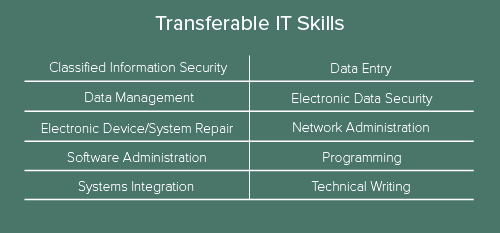
Transferable IT Skills

You will also want to build your resume around employers’ needs. Look at similar IT job postings and use these to determine which skills and experiences you should highlight in your resume.

You should create and freq. update a LinkedIn account. Many employers use this tool to learn more about job applicants. Having an up-to-date profile allows you to add and illustrate key information only hinted at on your resume.

Following these few simple tips will help you get a strong start and move forward in your transitioning process.

Find the Right Fit

It is essential to remember not all workplaces are equal. Some employers accommodate to veterans and their needs.

These employers may offer programs or services such as leadership development, support officers, mentoring programs or Employee Resource Groups (ERG) to help veterans easily adjust to their new work environment.

Furthermore, you want to be mindful of the type of culture and environment provided by the employer. Knowing this beforehand will ensure you find the right fit, and it will also prevent you from looking for another job due to dissatisfaction.

A few things you should research or ask about includes:

  • Flexible schedules
  • Opportunity for growth
  • Open or closed communication policy
  • Dress code
  • Leadership

If you prefer to continue working in a military setting, government contracting in IT is the right place for you. In this career field, you will typically work on a government site for a client, which is either a government agency or program.

Finding the right fit is critical to your success in your career. Taking time to look over the culture or veteran services offered will help you know that you are making the right decision.

Keep Your Clearance

Earning a security clearance during your military service makes you an attractive candidate to employers. But if you do nothing, you risk losing your clearance.

Active clearances are a precious commodity to many employers trying to fill cleared positions on government contracts, especially in IT. With a security clearance, you will often get offered up to a 20% premium compared to non-cleared applicants.

When you leave the military, your clearance becomes inactive. You have up to 24 months to get it reinstated as long as you haven’t missed your evaluation period. If you lose your security clearance, you will have to be sponsored by a company and go through the clearance process again to be reinstated.

However, the best way to ensure that you keep your clearance active is to put it to use. You can do this by working a cleared position within a company or government agency.

Don’t’ lose this valuable asset, make sure you can keep your security clearance.

Go from Novice to Expert

You learned a lot in the military, but what if you want to do something else? Having a variety of technical skills will help you quickly and easily gain employment in the IT field.

Picking up certifications at the end or after your military service is a sure way to make sure you have the skills employers want.

The military offers various programs and services to get veterans the license or certification they desire. These programs either document and test your education from your military service or offer you the opportunity to take courses to gain certification and licensing. The programs below will help you get started to earning your certifications today.
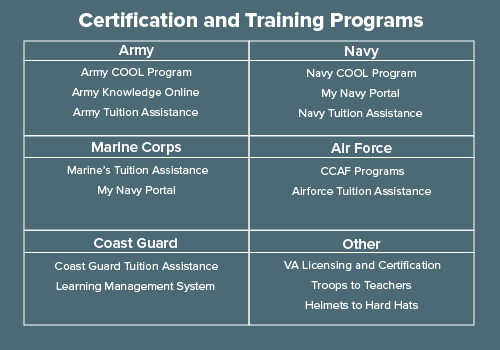
Certifications and Training Programs

Taking these few extra steps will increase your odds of landing the career you want. 

Make a Successful Transition

Following these 4 simple tips will help you secure an IT job after your military service. Each branch also offers transitioning programs to aid in this process. Contact your transition center for more information on the transitioning programs available to you.

To learn more about the IT careers available to you, take a look at the opportunities at Rivera Group or leave us a comment below. We’d love to help you get started on the next phase of your life today.

Snapshot of the Top 9 IT Careers

Are you at one of those big watershed moments in life, like college graduation or finishing a hitch in the military, and you know you want to work in IT but aren’t exactly sure where to begin? You’re not alone. With the rapid evolution of technology, IT is a field that’s constantly changing. We’ve put together this guide to help you make sense of the landscape and choose the best path for your experience and education. Scroll through this list and see if your skill set is represented.

IT Careers Infographic

How to Take the Initiative that Drives Success

What should you be doing that no one else has thought to do? This is a question we ask ourselves every day at Rivera Group.

When you recognize what needs to be done and take charge to make it happen, that’s what we call initiative. As one of our CORE4 values, we take the initiative to build revolutionary products and solutions and create better ways to get things done for our customers.

Doing Things No One Else Has

Risk is something we encounter every day, but when it comes to cyber threats of highly sensitive information, risk shouldn’t be handled lightly.

Prior to the development of EAGLE6, businesses struggled to maintain a secure and stable IT infrastructure. The available technology only alerted IT support after an attack had already occurred, which left companies to deal with the downtime and aftermath of the attack.

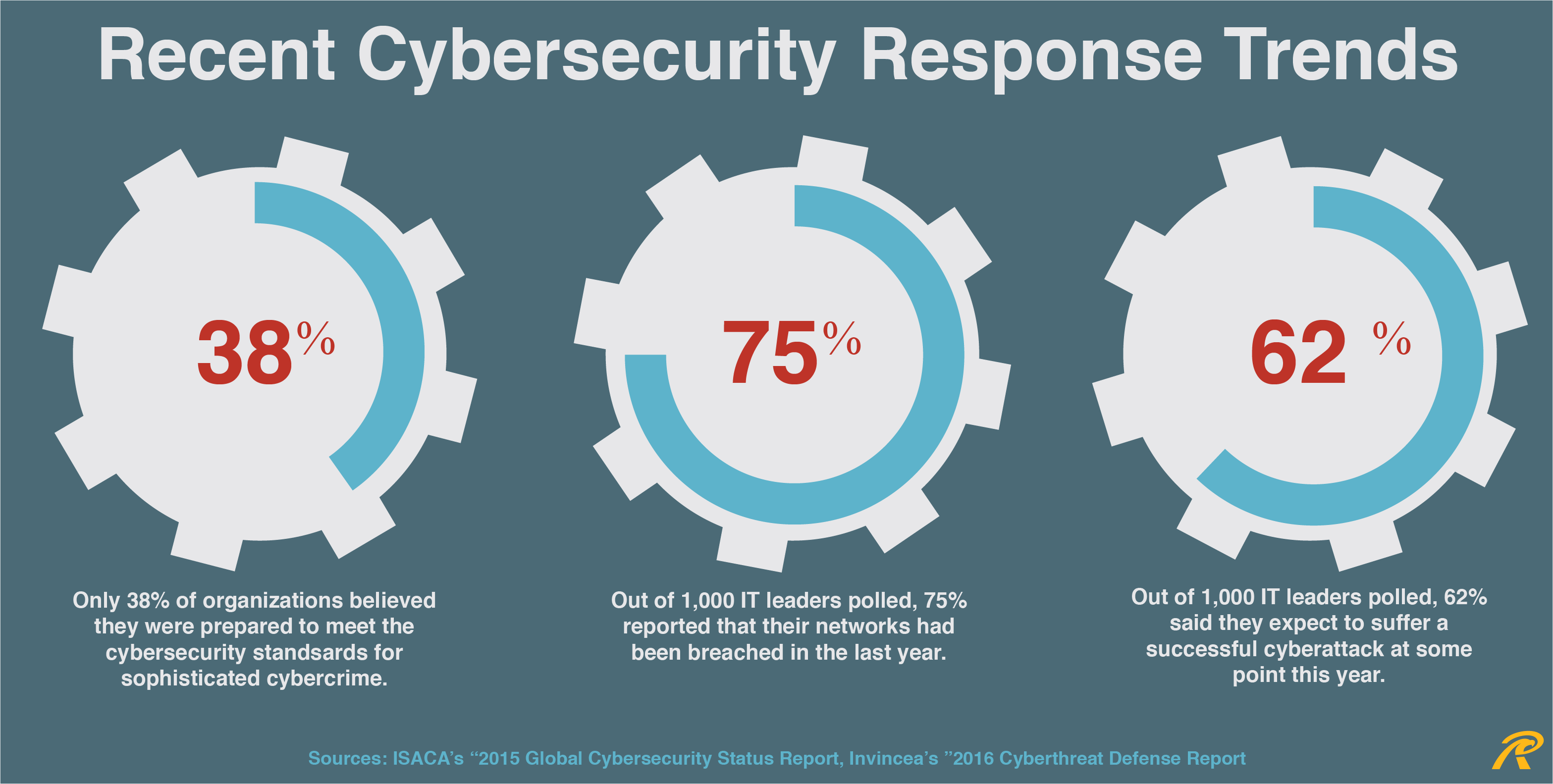
Recent Cybersecurity Response Trends

However, this problem didn’t go unnoticed. Dr. Joey Rivera, CEO of Rivera Group, realized this vulnerability and decided to do something about it.

After years of hard work, Joey and his team of software developers created a program that allows businesses to stay ahead of any unwanted states within their IT systems. Among the many features of EAGLE6, it’s cybersecurity tool alerts administrators of vulnerabilities before a cyber attack even happens.

Because of Joey’s initiative to fix a highly threating problem, this one of a kind product protects businesses from the loss of sensitive information and the high cost of remediation.

Taking Charge to Make It Happen

Initiative can be found in all of our teams at Rivera Group. It is what drives us to find the best ways to do what needs to be done.

Our National Geospatial-Intelligence Agency (NGA) team takes the initiative every day to ensure that our client receives the best technical engineering leadership in cybersecurity, sensor integration and Enterprise Configuration Management (ECM).

When working in such a complex environment, even daily tasks are very time-consuming to manage. To stay ahead of cyber-related events, our team must sift through numerous databases containing an abundance of information to find hidden threats.

Cybersecurity and EAGLE6

However, our Rivera Group team took the initiative and developed a system that made this process much quicker and easier.

They created a set of sophisticated queries, which allows the Source Cyber team to search through millions of documents almost instantly. Saving time on this tedious task gives the team more time to focus on information of value to help detect the sources of cyber threats.

Creating new processes and better ways to get things done is just one example of how our teams take initiative. We believe that you shouldn’t wait for success, instead, you should create your own.

Are You Taking the Initiative?

So, what should you be doing that no one else has thought to do? Take the initiative, find what needs to be done and take charge to make it happen.

Want to learn more about the work we do or the values that drive us? Check out our website or contact us for the latest information about Rivera Group and what we can do for you.

The Spark that Ignites Innovation

Picture a place full of creativity. Did you imagine an office building? Most people don’t usually think of creativity in business, but it is actually the starting point for innovation and progress.

Throughout history, numerous inventors have been told that their “crazy ideas” would never work, and the ones who ignored the skeptics and combined persistence with their creativity are the ones who went on to build great things. As a growing software development firm and IT services provider, we at Rivera Group define creativity as the process of continuously challenging the way we solve problems, and like the great inventors, we believe in persistence, even in the face of ridicule and misunderstanding. Creativity is so elemental to what we do that we have made it one of our CORE4 corporate values.

Leave Flying to the Birds

Although flying had always a been dream for the human race, it wasn’t until two brothers paired their creativity with determination that it became a possibility.

Orville and Wilbur Wright had a creative spark that was inspired by their observations. They set out to develop the first angled wings that would provide balance and control to allow an object heavier than air to fly.

Working out of their bicycle shop, the Wright brothers built several failed versions. Journalists, military specialists and many of their friends and family laughed at the Wright brother’s attempts at flight. Even Wilbur Wright noted, “Man will not fly for 50 years.”

For each effort at flight, the Wright brothers were risking their lives going up in a machine that might not work. Nevertheless, they let nothing stop them from making their “ridiculous” idea work.

The Wright Brother's Glider

After just two years, they finally created an ingenious engineering formula that let them take off into the sky and propel society into a future of flight.

Although people told them it was impossible, the brothers didn’t let this slow them down. Their creativity and resolve guided their innovation which led to an invention that would change the world.

It Just Can’t Be Done

For years, organizations have struggled to keep up with the rapid rate of change in the business and technology world. These attempts often leave IT administrators with a patchwork quilt of hardware, software, and business processes to maintain and protect.

In a world where the norm is to react to outages and attacks after they’ve occurred, one innovator envisioned a tool that could get out in front of a potential problem and alert administrators of the conditions that leave IT systems vulnerable to crashes and threats.

Dr. Joey Rivera, the CEO of Rivera Group, developed EAGLE6 to enable organizations to be proactive, rather than reactive, in preventing unwanted states within the IT systems they manage. As he developed his ideas for just such a tool, he was able to prove “on paper” that EAGLE6 would do what he envisioned, but many “experts” said the process was too complicated, that it just couldn’t be done. Undeterred, Joey continued to work to make the impossible possible.

As with all new ideas, EAGLE6 has overcome many challenges during its journey from idea to concept to the many iterations that have ultimately led to where the tool is today, being adopted by the U.S. military to support specific IT challenges.

Once Joey proved to himself that EAGLE6 could work, he summoned great feats of creative problem solving to prove that EAGLE6 would work, and when the skeptics expressed their doubts, he refused to fold. Instead, he persisted in pushing ahead, convinced of the power of EAGLE6 to deliver on his vision.

Igniting Innovation

Creativity is everywhere. In business, it is used to innovate new products and solve problems. As a software development company, creativity is the base of our success, and our CORE4 values guide our work in building great things.

Want to learn how creativity can improve your business? Take a look at our work or leave us a comment below. We’d love to hear from you!

Why Accountability is Essential

When most people think of accountability, they just connect it with responsibility, but it is actually a much more powerful than that.

At Rivera Group, we define accountability as the promise to take full ownership of our commitments. Along with our other CORE4 values, accountability guides our work and allows us to continue to build great things.

To do good work on time, accountability is essential for each step of the process. Implementing this value into your daily routine will lead to improved performance, higher job satisfaction, and increased creativity and innovation.

A World without Accountability

Bob Waterman tells a captivating story in his book, Adhocracy: The Power to Change, of how an energy company conquered their lack of accountability.

The employees understood that they were responsible for the way the company performed. However, ‘they’ was not a team, department or even anyone in the company. Rather, it was used as a nameless, faceless group that quickly became the center of blame. Employees would rationalize delayed or wrong work by explaining that they were the ones responsible for mistakes, which continuously caused costly errors.

To fight this absence of accountability, one bold company leader decided to use a sense of humor to remove they from the company. Posters were put up around the building that stated “Send they a letter,” and employees were given coffee mugs that read “Who are they anyway?”

Through his actions, this leader created a new mindset for the workers that greatly improved their accountability and explained that this was no longer an acceptable excuse.

Meeting Commitments

In a rapidly changing industry, our EAGLE6 team of software developers and engineers work in tight 14-day development cycles.

Georgette Jacobs, an EAGLE6 team leader, explains the prevailing mindset. “We’re a tight-knit team here, and we’re always working hard to meet what we’ve committed to – and holding each other accountable for any shortcomings.”

One team member, Patrick Rigney, understands he must first hold himself accountable before he holds the rest of the EAGLE6 team to the same standards. He continuously delivers exceptional work in a timely manner and encourages his co-workers to be accountable by sending out friendly reminders of the group’s commitments.

In this fast-paced environment, teammates rely heavily on the work of others to meet their commitments. For this group, accountability brings trust, and team members can rest assured that each individual will have their work ready for the rest of the team.

EAGLE6 Team

Some of the EAGLE6 team working on a 14-day software development cycle.

Focusing on the End Goal

Our IT Support teams work closely with our clients to ensure we create custom solutions that fit our client’s unique needs. Since these needs can often change, it is important to hold ourselves accountable to reaching the end goal.

“Accountability is such an important value that is pertinent to all aspects of life,” said Gena LaBuwi, an IT Services Program Manager, “As a part of the Rivera Group team, I strive to be accountable to my team members, my customers and my company each day.”

Many times, our IT support team will receive conflicting support requirements or different directions that can switch from one day to the next. However, our experienced IT staff focuses on the end goal of the project, and they don’t allow changes to slow them down.

Take Advantage of Accountability

Accountability is more than just accepting responsibility, it is a powerful tool that leads to trust and persistence. Without it, the wrong mindset can bring costly errors or missed deadlines.

At Rivera Group, we integrate accountability in each project and task that we take on because, without it, we’d never build great things.

IT Support is More Than Cables and Hardware

Information technology is expanding, and administrators are beginning to utilize IT support skills in nearly everything. At Rivera Group, our clients need custom IT support and solutions, which requires experience in unique IT work.

To maximize the return on investment for the Army’s marketing activities, the Army Marketing and Research Group (AMRG) turned to our experienced Enterprise Marketing Management (EMM) team who is able to use their IT skills to manage the marketing budget and track engagement with potential recruits.

What is EMM?

EMM is a computer-based system for managing the U.S. Army’s marketing budget. Marketing dollars are used to promote and recruit for the Army and range from billboards, cinema and magazine ads to booths at community events throughout the country.

With a massive amount of marketing dollars spent each year, the Army needs to verify the return on investment (ROI) of each marketing activity and see whether the money spent had positive results.

EMM Team

Rivera Group’s EMM Team

How is ROI measured?

A major metric for tracking positive ROI is lead generation. Getting an interested candidate’s name and contact information at a specific event or campaign can be tracked and counted as a lead. This information is passed on to a recruiter who then contacts the candidate to determine if the Army is a good fit. More leads mean a better ROI and determines whether the event should continue the next year, have changes made or dropped.

What role does EMM play?

EMM does quite a bit to manage marketing events for the Army, like:

financial planning, data entry of events, asset tracking of the Golden Knights/Army Semi-Truck/Rock Walls/etc., email campaigns, as well as usage of magazine/billboard/radio generated ads that can be modified to market to a specific location by providing local recruiter contact information.

How does the team manage all these details?

EMM is a Commercial Off the Shelf (COTS) browser application from Teradata utilizing Java, Java Scripting, .NET, SQL Server 2014 and Crystal Reports and is supported by a group of 8 team members in the roles of development, creative graphics, email specialist, support and project management.

With a customer base of approximately 1,400 users located throughout the United States, EMM supports GS, Agency and Army soldiers and interfaces with numerous internal and external systems. EMM provides a central location to enter data, generate reporting and manage marketing events.

Sounds complicated. How do you keep everything straight?

Modifications to the EMM product include the addition of a mapping tool which pictorially displays Army events, enabling drill down on event data good for briefings and high-level overview of marketing activities. Another major modification to EMM currently underway is the addition of merging ad graphics with text. The text is placed on an ad graphic indicating a local recruiter’s contact information, web link or a personalized message to promote the Army to a target audience.

Tim Robinson is the chief technical developer and has been with Rivera since 2014.  He’s excited about the benefits this new process brings to EMM as Teradata no longer supports this function. Tim recreated Teradata’s dropped functionality, and by starting from scratch, he has been able to better integrate the process, saving the end user 2-3 minutes when generating graphics in EMM.

Tim’s work also has him creating web services to interface with EMM’s multiple external vendor’s systems to efficiently transfer data across many different platforms.

Brian Howell, EMM’s email expert is streamlining the process of email campaign messaging. This can be quite sophisticated, as contact information such as name, age and Army job interest can be used to create specialized automated emails to better market to the individual. Email metrics such as link clicks and interests are tracked to provide an Army recruiter contact information as well as the ability to opt out. The focus of this work is getting the best job fit for the candidate to ensure they have the most positive impact when joining the Army team.

Our team is full of highly qualified Rivera folks like Tim and Brian along with our graphics and support team servicing the Army EMM contract since 2009.